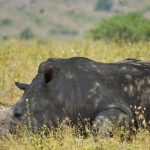
On your first game drive, someone in the vehicle will point at a grey shape in the bush and ask, “black or white?” Both rhinos are the same color, so this trips up almost every first-timer. I’ve watched guests squint at a rhino for a full minute trying to decide.
The good news is that once you know the black rhino vs white rhino differences, you can tell them apart in about three seconds. The better news is that in Kenya, you have a real shot at seeing both species on one trip, though the odds are very different for each. Here’s what actually separates them, and where to go if you want to see either one for yourself.
Why They’re Called Black and White If Both Are Grey
Neither rhino is black or white. Both are a dusty grey that shifts with whatever mud or dust they’ve rolled in that day. The names come from language, not color.
The white rhino’s name likely comes from the Dutch word “wijd,” meaning wide, describing its broad, square lip. English speakers heard “wijd” and turned it into “white.” Once that species had a color name, the other rhino got labeled “black” simply to be different. It’s a translation accident that stuck for over a century.
Size: Which Rhino Is Actually Bigger
The white rhino is the bigger of the two, and it isn’t close. A male white rhino can weigh 2,300 kg, roughly the weight of a small car. Black rhinos top out around 1,400 kg, closer to a large draft horse.
White rhinos also stand taller at the shoulder, typically 1.8 meters compared to about 1.6 meters for a black rhino. In the field, size alone can be a clue, but a young white rhino and a mature black rhino can look surprisingly close, so don’t rely on size by itself.
Lip Shape and Diet: The Real Tell
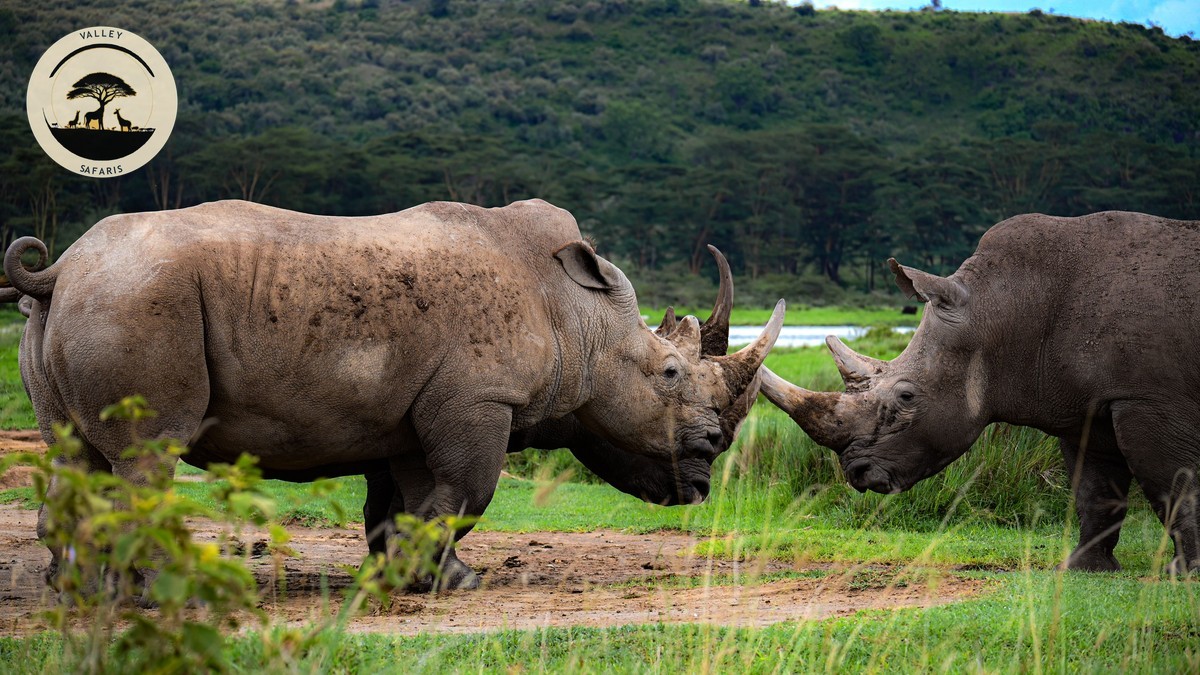
This is the one fact every article repeats, and it earns its place because it works. White rhinos have a wide, flat, square lip built for grazing grass, much like a lawnmower. Black rhinos have a narrow, pointed, hooked upper lip built for grabbing leaves, twigs, and shrubs.
If you get a clean side profile of the mouth, this is the most reliable single feature. The trouble is that rhinos don’t often pose for you, so guides lean on other clues too.
Black Rhino vs White Rhino Differences in Head, Ears, and Horns
Here’s what our guides actually watch for, beyond the lip trivia.
Head carriage is the fastest tell from a distance. White rhinos graze with their heads low, almost skimming the grass, because they eat downward. Black rhinos carry their heads higher, since they’re browsing at shrub height, and this gives them a more alert, upright posture even when calm.
Ears matter too. Black rhinos have rounder, more tufted ears that swivel constantly, tuned to a species that relies more on hearing in dense bush. White rhino ears are larger and more tubular, but read as calmer since the animal spends more time in open grassland with clearer sightlines.
Both species have two horns made of keratin, the same protein in your fingernails and hair, not bone. On a black rhino, the front horn is often longer and more curved. On a white rhino, there’s typically a visible hump on the back of the neck, supporting that big grazing head, which black rhinos lack.
Behavior: Solitary Tracker vs Social Crash
Black rhinos are mostly solitary. You’ll usually find one animal, occasionally a mother with a calf, moving through thick bush alone. White rhinos are more social and often gather in small groups called a crash, sometimes four to six animals grazing together in open grassland.
This difference shapes how a sighting actually feels. A white rhino encounter at Lake Nakuru National Park often means several animals in view at once. A black rhino encounter tends to be one animal, briefly, before it moves back into cover.
Which Rhino Is More Dangerous
Black rhinos have the more aggressive reputation, and it’s earned. They’re more likely to charge when startled, partly because their poor eyesight in dense bush means they often don’t identify a threat until it’s close. White rhinos are generally calmer and more tolerant of vehicles, largely because their open habitat gives them more warning before something gets near.
Neither animal is looking for a fight, and guides keep a respectful distance regardless of species. If you want a fuller picture of which animals in Kenya actually cause the most incidents, our guide to staying safe around Kenya’s most dangerous animals covers it well, and cape buffalo, not rhino, top that list.
Habitat and Where Each Roams
Black rhinos prefer thick bush, scrubland, and broken terrain where they can browse and hide. White rhinos prefer open savanna and grassland, which suits their grazing style and social groups. This habitat split is exactly why sightings feel so different in the field. Open grassland means white rhinos are easier to spot, while black rhinos can be twenty meters away in thick cover and invisible.
Conservation Status and Population Numbers
Both species were pushed to the edge by poaching in the 20th century, but they’ve landed in very different places today.
Southern white rhinos number roughly 16,000 across Africa, making them the more numerous of the two, though still far below historic levels. Black rhinos number around 6,300 continent-wide, classed as critically endangered by the IUCN. Kenya holds a meaningful share of both populations thanks to fenced conservancies with active anti-poaching patrols.
Where to See Each One in Kenya
This is the part most articles skip, and it’s the part that actually matters for planning your trip. Here’s an honest look at your odds on a standard 3 to 4 night Kenya itinerary.
| Location | Distance from Nairobi | Drive Time | Entry Fee (approx.) | White Rhino Odds | Black Rhino Odds |
|---|---|---|---|---|---|
| Ol Pejeta Conservancy | 200 km | 3.5 hrs | USD 90 per adult, per day | Near guaranteed | Good, has largest black rhino population in East Africa |
| Lake Nakuru National Park | 160 km | 2.5 hrs | USD 60 per adult, per day | Near guaranteed | Occasional, requires luck |
| Solio Rhino Sanctuary | 220 km | 4 hrs | Included with most lodge stays nearby | Very good | Very good, dedicated sanctuary |
| Maasai Mara conservancies | 270 km | 5 to 6 hrs | Varies by conservancy, roughly USD 70 to 100 per day | Rare | Rare, but present in some private conservancies |
If seeing a black rhino matters to you, Ol Pejeta and Solio are your best bets, and some lodges there offer a dedicated rhino tracking activity for an extra USD 30 to 50 per person. White rhino sightings, on the other hand, are close to guaranteed at Ol Pejeta or Nakuru on almost any game drive. That’s the honest trade-off: easy odds for white rhino, a bit of effort and luck for black rhino.
How to Tell Them Apart Quickly From the Vehicle
When you only get a few seconds, run through this order: head height first, group size second, ear shape third. A low head grazing in open grass with others nearby is white rhino. A single animal with its head up, disappearing into bush, is black rhino. Save the lip check for when you get a clear photo.
Speaking of photos, rhinos are often distant or partly hidden by scrub, so glass matters here more than with lion or elephant. Our post on the best telephoto lens for photographing rhinos walks through what to pack if you want sharp shots rather than grey blobs in the frame.
The Valley Safaris Difference
Any guide can tell you the lip shape trick. What we focus on is setting expectations before you land, so you’re not disappointed halfway through your trip. If black rhino sightings matter to you, we build your itinerary around Ol Pejeta or Solio from day one, rather than hoping you get lucky in the Mara.
We also brief every guest on realistic odds, not marketing promises. Our guides radio ahead between vehicles when a rhino is spotted, and they know the specific territories individual animals favor at Ol Pejeta and Nakuru. That local knowledge, built over years of driving these same roads, is the difference between a rushed glimpse and ten unhurried minutes watching a rhino graze. If rhinos are a priority, tell us early and we’ll build your route around it.
Rhinos are just one piece of the puzzle. If you want the fuller picture of what else to plan around, our guide to where to see the Big Five in Kenya is a good next stop.
FAQ
What is the main difference between a black rhino and a white rhino? Lip shape and diet. White rhinos have wide, square lips for grazing grass. Black rhinos have narrow, hooked lips for browsing shrubs and leaves.
Why are they called black and white if both are grey? The name comes from a mistranslation of the Dutch word “wijd” (wide), describing the white rhino’s lip, not its color.
Which rhino is bigger, black or white? White rhinos are bigger, reaching up to 2,300 kg compared to about 1,400 kg for black rhinos.
Which rhino is more dangerous or aggressive? Black rhinos have a reputation for charging more readily, often due to poor eyesight in thick bush.
Which rhino is more endangered or rare? Black rhinos are more endangered, with around 6,300 left, classed as critically endangered. White rhinos number roughly 16,000.
Where can I see black and white rhinos in Kenya? Ol Pejeta Conservancy and Solio Rhino Sanctuary offer good odds for both. Lake Nakuru is near-guaranteed for white rhino.
What do black rhinos eat vs. white rhinos? Black rhinos browse leaves, twigs, and shrubs. White rhinos graze almost entirely on grass.
How can you tell a black rhino from a white rhino at a distance? Check head height first. White rhinos graze with heads low. Black rhinos carry their heads higher and more alert.
Which rhino has bigger ears, and why? White rhinos have larger, more tubular ears, suited to open grassland. Black rhino ears are rounder and more tufted, suited to dense bush.
Which rhino is more social and lives in groups called a crash? White rhinos are more social and often gather in small groups. Black rhinos are largely solitary.
What are rhino horns made of? Keratin, the same protein found in human hair and fingernails, not bone.
Can you see both species on the same Kenya safari? Yes. Ol Pejeta and Solio both host healthy populations of black and white rhino within the same conservancy.
Ready to build a rhino-focused itinerary around Ol Pejeta, Solio, or Nakuru? Visit our Kenya safari tours page, or reach out through our contact page and we’ll help you plan the details.