The first time a guest on one of our trips saw a lone buffalo bull standing in the grass near Amboseli, she asked why our guide slowed the vehicle down more for him than she had for a pride of lions a day earlier. Fair question. Lions get top billing on every safari poster, but ask any Kenyan guide which animal worries them most on foot, and most will say the cape buffalo.
If you’re planning your first trip and keep reading about “the widowmaker,” this post breaks down cape buffalo attacks and safari safety in Kenya: what the nickname actually means, where the real risk sits, and exactly what your guides do to manage it. Short version: you are almost certainly going to be fine. But it helps to know why, not just be told so.
Why Cape Buffalo Are Called ‘The Widowmaker’ or ‘Black Death’
Cape buffalo earned these nicknames because of how they attack, not just because they attack. A wounded or cornered buffalo doesn’t simply run or charge once. It often circles back through cover, waits, and ambushes whatever wounded it, whether that’s a lion or a hunter. Old accounts from hunting guides across East and Southern Africa describe this pattern as one of the reasons buffalo felt more dangerous than animals that are physically more powerful.
The “black death” tag comes from the same reputation, plus the animal’s dark, almost black hide and its habit of appearing calm right up until it isn’t. A buffalo herd grazing quietly 80 meters from your vehicle looks like the least dramatic thing on the plains. That calm is part of what catches people off guard.
The Physical Stats Behind the Reputation
Cape buffalo are built like tanks, and the numbers back that up.
| Stat | Cape Buffalo |
|---|---|
| Weight (bull) | 700 to 900 kg, with some large bulls over 1,000 kg |
| Shoulder height | Around 1.5 to 1.7 meters |
| Horn span | Up to 1 meter across, fused into a bony “boss” on mature bulls |
| Top speed | Roughly 55 to 57 km/h (about 35 mph) over short distances |
| Herd size | From small bachelor groups of 2 to 5 bulls up to herds of several hundred |
| Lifespan | 15 to 20 years in the wild |
That horn boss is worth understanding. On a mature bull, it forms a solid shield across the forehead, which is one reason a frontal charge is so hard to stop and why guides teach clients never to assume a buffalo will bluff first.
Why Cape Buffalo Are So Unpredictable
Elephants usually give warning signs. Ears out, mock charges, trumpeting. Buffalo often skip the warning stage. A herd can look completely relaxed and then react to a scent, sound, or sudden movement with no buildup at all.
Part of this comes down to poor eyesight paired with a strong sense of smell and hearing. A buffalo may not clearly see what’s approaching, so it reacts to sound and scent instead, and by the time it identifies a threat, it’s already close. That’s very different from an animal that tracks a threat visually from a distance and telegraphs its response.
Lone Bulls vs. Herds: Who’s More Dangerous
This is one of the most useful things to understand before your trip, and it’s the piece most generic articles skip.
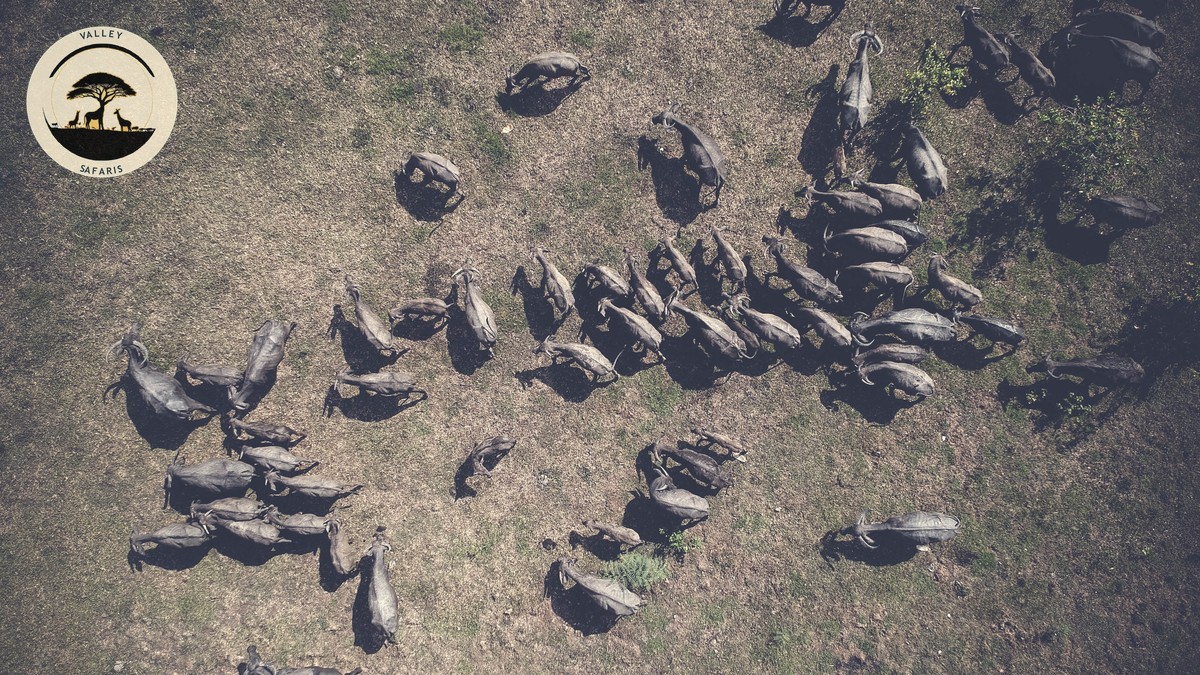
A buffalo herd, even a large one, usually has a clear structure. Cows and calves stay near the center, and the herd tends to move away from disturbance as a group. Lone bulls are different. Older males pushed out of the herd, often nicknamed “dagga boys” for the mud they wallow in, live alone or in small bachelor groups. They have no herd to retreat with, they’re often carrying old injuries from past fights or predator encounters, and they tend to stand their ground rather than run.
Our guides treat a solitary bull near a track, a camp fence line, or a walking route with far more caution than a full herd grazing in open ground. It’s the single biggest behavioral distinction worth knowing before you land in Nairobi.
Death Toll and How Buffalo Compare to Other Dangerous Animals
You’ll see a figure repeated across almost every article on this topic: cape buffalo kill around 200 people a year across Africa. That number gets cited constantly, but it isn’t drawn from one clean, current official source, so treat it as a widely used estimate rather than a verified statistic. What is well documented is that buffalo, hippos, and elephants are consistently ranked among the most dangerous large mammals to humans on the continent, ahead of lions and leopards, mostly because buffalo and hippos are encountered more often on foot near water and farmland, and because their attacks are harder to survive without medical help nearby.
For a tourist on a standard game drive in a closed vehicle, actual attack risk is very low. The danger climbs when people are on foot, near dense bush, or moving through camp at night, which is exactly where good guiding earns its keep.
Cape Buffalo Attacks and Safari Safety in Kenya: Where the Real Risk Sits
Buffalo live across most of Kenya’s major parks, but incidents cluster in specific conditions rather than specific parks.
The Masai Mara has large resident herds and dense grass cover, which means closer encounters, especially near river crossings and thicker bush along the Mara and Talek rivers. Amboseli’s swamps draw buffalo in for grazing, often putting them near foot paths used by staff and walking guests. Aberdare National Park is the one guides mention most for a different reason: its dense montane forest limits visibility to a few meters in places, so buffalo can be extremely close before anyone sees them, whether on foot or in a vehicle.
| Park/Region | Distance from Nairobi | Typical Drive Time | Non-Resident Park Fee (per adult, per day) | Buffalo Risk Notes |
|---|---|---|---|---|
| Masai Mara National Reserve | About 270 km | 5 to 6 hours by road, or 45 min flight | USD 200 (Jul to Dec 2026 peak rate) | Large herds near river crossings and thick riverine bush |
| Amboseli National Park | About 240 km | 4 to 4.5 hours by road, or 30 to 40 min flight | USD 90 | Swamp-edge grazing near foot paths and camp perimeters |
| Aberdare National Park | About 150 km | 2.5 to 3 hours by road | USD 70 to 80 (indicative, confirm at booking) | Dense forest cuts visibility, close encounters more likely |
Prices shift with KWS and county council policy, so always confirm current rates with your operator before travel.
General Safety Rules on Game Drives
Inside a closed safari vehicle, buffalo have almost never been recorded flipping or attacking simply because a vehicle was nearby, provided people stay inside it. Buffalo generally treat a vehicle as one large, unfamiliar shape rather than prey or a threat, as long as no one stands up, leans out, or makes sudden noise.
The rules our guides follow, and ask guests to follow too:
- Stay seated inside the vehicle unless a guide explicitly says otherwise.
- Keep at least 25 to 30 meters from a resting or grazing herd, more from a lone bull.
- No sudden arm movements or loud noise, especially near a solitary bull.
- Let the guide choose the approach angle and always leave a clear retreat path for the vehicle.
Whether you’re in an open-sided Land Cruiser or a closed vehicle with a pop-up roof also changes how close a guide will comfortably position you. If you’re deciding between vehicle types for your trip, it’s worth reading how vehicle choice affects your safety around buffalo on a game drive before you book.
Walking Safaris and Buffalo Risk
This is where honesty matters. Walking safaris in areas like the Aberdares or private conservancies bordering the Mara are genuinely different from a vehicle-based game drive. On foot, you lose the vehicle’s size advantage and the ability to retreat quickly.
Licensed walking guides in Kenya carry rifles for exactly this reason, and they’re trained to read wind direction, scan for lone bulls before entering thick cover, and keep groups tight and quiet. If you want a walking safari on your trip, ask your operator directly how many armed guides accompany each group and what the group size limit is. A ratio of one armed guide per 6 to 8 guests is a reasonable standard to look for.
Buffalo Near Camp at Night
Buffalo do wander into unfenced camps after dark, particularly in areas like the Mara conservancies and around Amboseli, drawn by grass near tent lines. This is normal and rarely dangerous if camp protocol is followed: staying inside your tent after the camp’s night curfew, using an escort to walk between tents after dark, and never walking to a bathroom or mess tent alone at night.
It’s worth understanding how safe your tent actually is at night with predators (and buffalo) around before your first night at an unfenced camp, since the canvas walls do more to keep animals from noticing you than most guests expect.
What to Do If a Cape Buffalo Charges You
This should never come up on a vehicle-based safari, but if you’re on a walking safari and your guide gives an instruction, follow it immediately, without pausing to ask why. Generally that means:
- Get behind the nearest solid cover, a large tree or termite mound, not just tall grass.
- Never run in a straight line across open ground; buffalo are faster than you over any real distance.
- If a tree is climbable, climbing it is a legitimate last resort.
- Let the armed guide lead the response. Their job is to manage exactly this situation.
A packed first aid kit matters here too. Even a minor scrape from a fast retreat through thorny bush is worth treating properly, so check what to pack in your safari first aid kit before you travel.
The Valley Safaris Difference
Every Valley Safaris guide carries a radio, and every vehicle checks in before approaching dense bush, river crossings, or any area with reported buffalo activity that day. Guides share sightings across the radio network in real time, so if a lone bull was spotted near a track an hour ago, the next vehicle knows before it gets close.
For walking safaris, we only work with conservancies and lodges that provide licensed, armed guides at a ratio of no more than 8 guests per guide, and we brief every walking group on buffalo behavior before setting out, not just a generic safety talk. At camp, we choose properties with clear night escort protocols and brief every guest on arrival, not buried in a welcome pack nobody reads.
None of this is about frightening first-time travelers. It’s about the same thing our guides do every day: respect a genuinely powerful animal, know its patterns, and put simple, consistent habits between you and it.
Plan Your Safari With Us
Curious how a Masai Mara or Amboseli itinerary would work for your dates and budget, buffalo safety included? Have a look at our Kenya safari tours or get in touch through our contact page and we’ll help you plan a trip that fits.