Every packing guide gives you the same safari lodge dinner dress code advice: smart-casual, no formal wear, avoid black. That advice is fine, but it does not help you actually pack a bag. It also ignores the one thing that changes everything. You will fly to your camp in a plane the size of a minibus, and your bag has to weigh under 15 kilograms.
I have watched guests unzip a duffel at Kicheche Mara Camp and pull out a cocktail dress they never wore once. Nobody needed it. Nobody was judging the guy in a clean fleece and hiking trousers either. Let’s talk about what dinner dress code on a Kenya safari actually looks like, and how to pack for it without wasting space.
The Real Safari Lodge Dinner Dress Code in Kenya
There is no dress code, not in the way a restaurant in Nairobi’s Karen suburb might have one. Camps and lodges across Kenya expect guests to show up clean, comfortable, and a little tidier than they looked on the afternoon game drive. That’s it.
Dinner at most camps happens around a communal table, sometimes by a fire pit, sometimes under a thatched roof open to the bush. Nobody is checking shoes or judging jewelry. The whole point of the evening is conversation, good food, and listening for hyenas outside the light of the lanterns.
What changes between camps is the level of polish, not the rules. A mobile tented camp in the Maasai Mara feels more rustic during migration season. A permanent lodge in Laikipia, with a wine cellar and a slightly smarter dress code, feels more polished. Both are still casual by any city standard.
What to Actually Wear to Dinner
Think capsule wardrobe, not costume change. The same trousers or skirt you wore on the morning drive can go straight to dinner if you swap the dusty shirt for a clean one.
A good dinner outfit on safari usually means:
- A clean, breathable top, cotton or a technical travel fabric that does not wrinkle
- Trousers, a skirt, or a light dress in a neutral tone
- A cardigan, fleece, or light jacket for when the temperature drops
- Closed shoes or clean sandals, nothing muddy from the drive
That is genuinely it. Pack two or three tops that mix and match with one pair of trousers and one skirt or dress. That covers five nights without repeating an obvious outfit twice in a row.
Evening Temperatures and Layering
This is the part most guides skip, and it matters more than color choice. Kenya sits on the equator, so daytime heat can trick you into thinking evenings stay warm. They do not, especially at altitude.
The Maasai Mara sits around 1,500 to 2,100 meters above sea level. Nights from June through September can drop to 8 to 12 degrees Celsius. That is cold enough that guests wrap up in blankets on the way to the dining tent. Laikipia’s plateau, home to conservancies like Ol Pejeta, gets similarly cool after dark. Samburu and Laikipia’s lower valleys sit under 1,000 meters, so evenings there stay milder, typically 16 to 20 degrees.
A camp like Elephant Watch Camp in Samburu will feel noticeably warmer at 8pm than a tent in the Mara Triangle in the same week. Pack one proper fleece or packable down layer regardless of where you are headed. Add a scarf or shawl, since it doubles as a blanket on chilly evening game drives too.
Colors to Avoid and Why
Skip black and dark blue. Both colors attract tsetse flies, which bite hard and are common in wooded areas of the Mara, Samburu, and parts of Tsavo. It is not a fashion rule, it is a practical one born from experience.
Bright colors and pure white are worth avoiding too, though for different reasons. Bright patterns can spook wildlife on the way to dinner if you are walking through camp after dark. White shows every speck of red Mara dust within an hour of arrival. Stick to khaki, olive, sand, and soft earth tones. They hide dust, blend into the bush, and photograph well by lamplight.
When Lodges Do Dress Up
A handful of high-end properties nudge guests toward something smarter. Angama Mara and &Beyond camps both lean into a slightly more polished evening look. This is especially true if the camp offers à la carte dining rather than a communal table. Think a linen shirt instead of a t-shirt, or a simple dress instead of shorts.
Even then, nobody expects heels or a blazer. “Smarter” on safari means neat and put together, not formal. If you are booked at one of these camps, one slightly nicer outfit in your bag covers you for the whole trip.
Footwear for the Evening
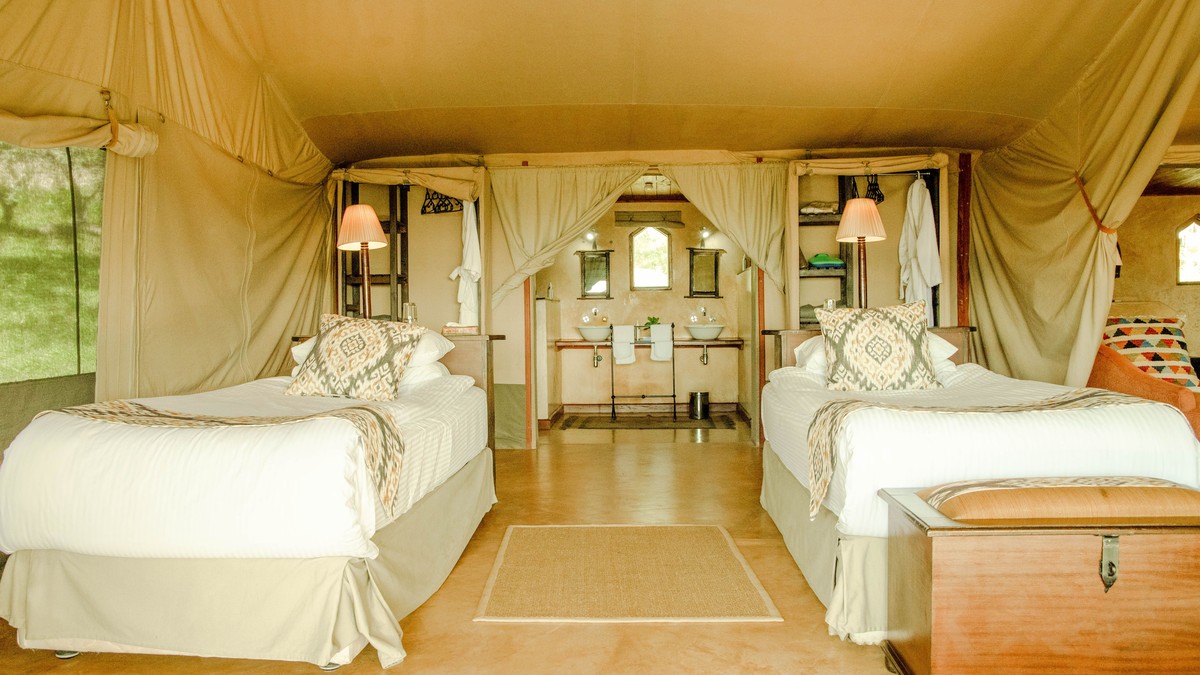
Leave the game-drive boots at the tent door. Most camps keep a pair of camp slippers or sandals by your bed for exactly this reason, so you are not tracking dust into the dining area.
Pack one pair of comfortable closed shoes, like a canvas sneaker, and one pair of sandals or flip-flops. Paths between tents are often unlit and uneven, so avoid anything strappy or hard to walk in after dark. Staff usually escort guests with a torch past the point where wildlife might wander through camp.
Laundry Service Means You Can Pack Less
Nearly every lodge and tented camp in Kenya offers same-day or next-day laundry, often included in the rate. A five-night stay does not need five dinner outfits. Two or three, washed and rotated, will get you through comfortably.
Ask at check-in what is included. Some camps skip washing delicates as a courtesy, but shirts, trousers, and socks come back folded on your bed by evening. This single fact does more to lighten your suitcase than any packing hack.
The Luggage Limit Nobody Tells You About
Here is the constraint every generic packing list ignores. If your itinerary includes a flight between parks, on operators like Safarilink or AirKenya, you are usually held to 15 kilograms total in a soft-sided bag. The limit is sometimes lower depending on the aircraft and route. Hard suitcases are often refused outright because they do not fit the cargo hold of a 12-seat Cessna Caravan.
That limit is the real reason “just bring a nice outfit for dinner” is unrealistic advice. Fifteen kilos has to cover game-drive clothes, sleepwear, a swimsuit, toiletries, and dinner wear. Read up on light-aircraft luggage weight limits before you pack, because it changes how you plan every outfit, not just the evening one.
One more small but real detail: Kenya banned single-use plastic bags in national parks and reserves back in 2017. Pack your dinner shoes or laundry in a fabric pouch instead of a plastic bag. Kenya’s plastic bag ban is enforced at park gates and even in luggage checks.
Dinner Dress Comparison by Region
| Region | Distance/transfer from Nairobi | Evening temp, Jun-Sep (indicative) | Reserve/conservancy fee per person/night (indicative) | Dinner dress note |
|---|---|---|---|---|
| Maasai Mara (Mara North Conservancy) | 270 km road, or 45-min flight | 8-12°C | around USD 100 | Fleece essential, smart-casual |
| Samburu National Reserve | 325 km road, or 50-min flight | 16-20°C | around USD 75 | Light layer usually enough |
| Laikipia Plateau (Ol Pejeta area) | 220 km, 3.5-4 hr drive | 9-13°C | around USD 90 | Fleece plus light jacket |
| Amboseli National Park | 240 km road, or 45-min flight | 12-16°C | around USD 60 | Smart-casual, light layer |
These figures shift with season and camp, so treat them as planning ranges, not fixed prices.
The Valley Safaris Difference
We plan itineraries around what people actually need to pack, not just where they sleep. When we build your trip, we tell you the real evening temperature at each camp and whether laundry service is included. We also tell you the luggage allowance on every internal flight, before you ever start packing.
We have sat at enough dinner tables in the Mara and Samburu to know that guests relax faster when nobody is worrying about what to wear. So we say it plainly during planning calls: bring layers, skip black. Trust a clean shirt and a fleece over a suitcase full of options you will not use.
Ready to Plan Your Kenya Safari?
If you are working out what to pack, we are happy to walk through it camp by camp as part of planning your trip. Have a look at our Kenya safari tours or visit our contact page to start putting together an itinerary that fits how you actually want to travel.