If you have already done the Mara game drives and ticked off the Big Five, the Ngare Ndare Forest canopy walk is the kind of experience that resets your idea of what a Kenya trip can look like. It sits between Lewa Wildlife Conservancy and Mount Kenya. Instead of open savannah, you get a cool, dripping cedar and podo forest, with a swinging walkway above the canopy and turquoise pools below it. It is an easy add-on if you are already staying in Laikipia, and a rewarding detour even if you are not.
This guide sorts out the confusing, conflicting fee numbers floating around online, and gives you the actual road directions, not a rough estimate.
What the Ngare Ndare Forest canopy walk actually is
The Ngare Ndare canopy walkway is often called the longest of its kind in East Africa, stretching about 450 meters through the treetops. Suspended sections reach roughly 12 to 15 meters above the forest floor, held up by steel cables strung between raised platforms and giant podocarpus trees. It sways a little as you walk, which surprises first-timers, but it is netted on both sides and built for regular foot traffic.
Walking the full loop, including the descent to the river, takes most visitors about one to two hours at an easy pace. It is not strenuous, but there are steps and some uneven forest trail, so it is not ideal for anyone with serious mobility issues.
The blue pools and swimming safety
Below the canopy walk, the Ngare Ndare River drops through a series of pools and small waterfalls. The water has a striking blue-green color, caused by mineral content and shaded, still water. They are genuinely beautiful, and swimming is allowed in the designated pool near the main falls.
Here is the part some blogs gloss over: swimming is meant for confident swimmers only, and rangers ask you to stay in the marked area. The current can be stronger than it looks near the falls. The pool also sits inside forest, so a ranger must accompany your group anyway. If you cannot swim well, wading at the edge or just enjoying the view is the safer call. Treat any ranger instruction to stay out of the water on a given day as final, usually tied to recent rain and water levels.
Wildlife you might see
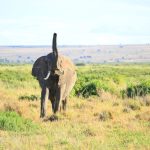
Ngare Ndare is a forest reserve, not a game park, so sightings are different from a Mara or Samburu drive. Elephants use the forest as a corridor between Lewa and Mount Kenya, and they gather at a forest swamp on their route. Seeing them is seasonal and never guaranteed. You have a better chance in the drier months when they move through more predictably.
What you can count on is black and white colobus monkeys moving through the canopy. There is also a strong variety of forest birds, including turacos and hornbills. Buffalo tracks are common, and there is a real chance of meeting buffalo or elephant on foot trails. That is exactly why the mandatory ranger escort matters.
Entry fees and charges
Prices quoted online vary widely, some in flat USD, some in outdated KES tiers. The figures below reflect the Ngare Ndare Forest Trust’s own current rate card.
| Fee category | Resident rate | Non-resident rate |
|---|---|---|
| Entry, per adult | KES 2,000 | KES 4,000 |
| Vehicle entry | KES 500 | KES 1,000 |
| Ranger escort (mandatory, per group) | KES 1,000 | KES 1,000 |
| Camping, per person per night | KES 3,000 | KES 5,000 |
Child rates typically run lower than the adult fee. The exact discount is best confirmed at booking rather than assumed, since it can shift between seasons. Fees are collected only through M-Pesa at the gate, so cash-only visitors are often turned away or delayed while someone finds signal to pay. Bring your phone charged and your M-Pesa float ready.
These fees are not just an entry cost. They are part of how park and forest fees fund conservation in this corridor. They pay for rangers, trail maintenance, and community programs that keep the forest intact between two much larger protected areas.
How to get there
Ngare Ndare sits about 34 kilometers from Nanyuki town, and roughly 250 kilometers from Nairobi.
| Route | Distance | Approx. drive time | Road notes |
|---|---|---|---|
| Nairobi to Nanyuki | 200 km | 3 to 3.5 hours | Tarmac, via Nyeri |
| Nanyuki to Timau | 30 km | 30 minutes | Tarmac, A2 highway |
| Timau to Ngare Ndare gate | 15 km | 30 to 45 minutes | Murram, C77 road |
The last stretch off the C77 turns to sticky mud in the long and short rains, roughly April to June and October to November. A 4×4 is strongly recommended during those months, and a normal saloon car can genuinely get stuck. In the dry season, a careful driver in a regular car can usually manage it, but a 4×4 still removes the guesswork.
The budget route by public transport
If you are traveling without a vehicle, matatus run frequently from Nanyuki town toward Timau along the A2. From the Timau junction, boda-boda riders know the C77 turnoff. They will take you the rest of the way to the gate for a negotiated fare. It is a workable budget option, but plan for a full day, since return transport back to Timau is easier to arrange in daylight.
Best time to visit
The dry months, roughly June to October and January to February, give you the easiest driving and clearer river pools. Your odds of seeing elephants in the forest corridor are also better. The rains bring greener forest and a fuller river, which is dramatic at the falls. They also bring mud on the access road, and the swimming pool may close for safety.
What to bring and fitness level
Closed walking shoes with grip matter more than anything else here, since the canopy platforms and river rocks get slick. Bring a light rain jacket even in the dry season, since forest weather shifts fast. Insect repellent, a swimsuit if you plan to swim, a dry bag for your phone, and cash in small notes for tips round out the list. The walk itself suits most fitness levels, including reasonably active children and older visitors, as long as steps and short climbs are not a problem.
Camping and nearby stays
The Trust runs a basic campsite inside the forest, with the fees listed above. It has toilets and a cooking area, but you bring your own tent, food, and water. For something more comfortable, the wider Lewa area has lodges and tented camps ranging from mid-range to high-end. Most sit within a 30 to 45 minute drive of the forest gate. If you are still deciding where to base yourself for this side of Kenya, our guide to choosing a conservancy like Lewa as your base walks through the trade-offs. It covers the main options in Laikipia.
Booking ahead
Group and school visits need advance booking. Even independent travelers benefit from calling two to three days ahead, especially in peak season or around Kenyan school holidays. Walk-up visitors are usually accommodated. A booked slot guarantees a ranger is free to walk you through, and that the pool is open that day.
Why this forest matters
Ngare Ndare is community-owned and trust-managed, which is part of why the fee structure feels different from a national park. Revenue supports the Ngare Ndare Forest Trust’s rangers and reforestation work, and a share flows back to the surrounding community. The forest also forms a living link in the wider Mount Kenya ecosystem. That link is part of the broader story covered in our piece on Kenya’s UNESCO World Heritage safari sites, since Mount Kenya itself holds that status. This corridor is what keeps elephants moving safely between it and Lewa.
The Valley Safaris Difference
We have walked this canopy in both blazing sun and drizzle, and we know which weeks the pools run clear versus murky. When we build a Laikipia itinerary, we time your Ngare Ndare visit around the Trust’s actual booking windows. We arrange a 4×4 transfer when the C77 is likely to be muddy, and pair the forest with a Lewa-based stay. That way it feels like a natural half-day out, not a rushed detour. We also carry small M-Pesa float for guests who prefer not to manage gate payments themselves.
Plan your visit
Ready to add Ngare Ndare Forest to a Laikipia or Lewa itinerary? Get in touch through our contact page and we will build the logistics around your dates.