You’ve found a wildebeest migration live tracker. It shows a pin near the Sand River, or maybe the Mara River at Lookout Hill. Now what?
That’s the part most guides skip. They’ll show you a map, list ten camps, and leave you to guess whether “hot right now” means you should call your travel agent tonight or wait three weeks. After twenty years running safaris through the Mara and into the Serengeti, I can tell you the honest answer: a tracker pin is a clue, not a promise. Here’s how to read one properly, and what to actually do with it.
What the great wildebeest migration actually is
Around 1.3 to 1.5 million wildebeest move through the Serengeti-Mara ecosystem every year, alongside roughly 200,000 zebra and 300,000 Thomson’s gazelle (indicative range, based on long-term aerial census estimates). They aren’t following a fixed route on a fixed date. They’re following rain, and rain shifts a little every year.
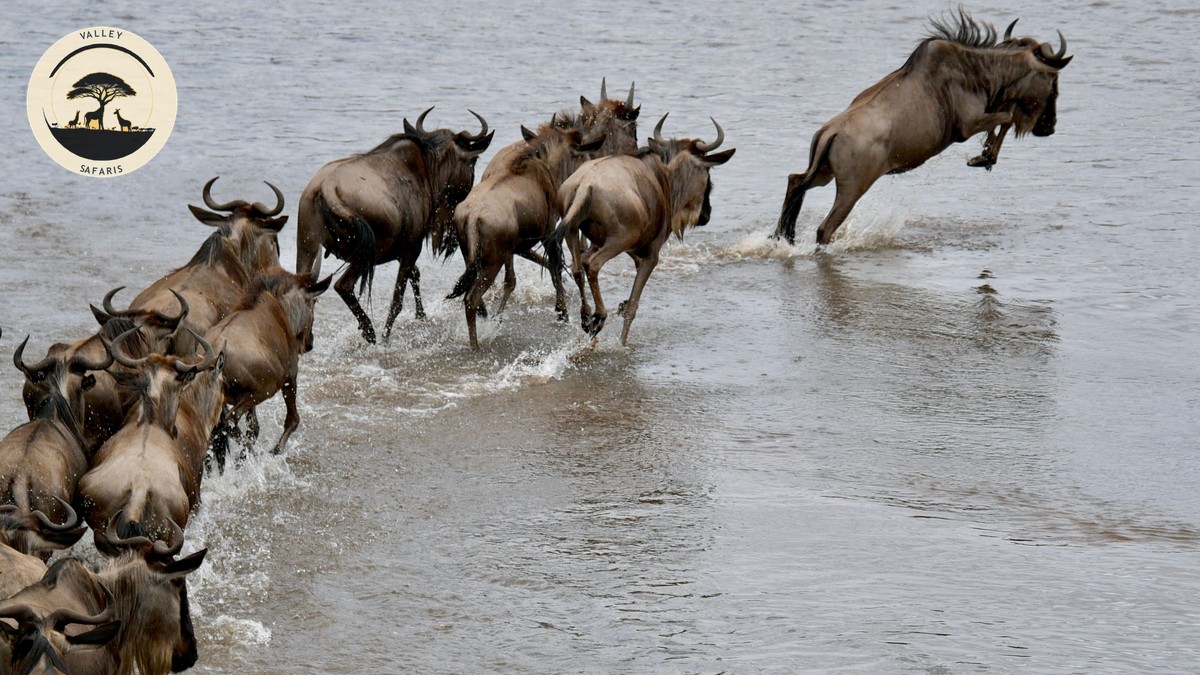
The rough loop runs south to north. Calving happens on the short-grass plains around Ndutu and southern Serengeti from January to March. Herds push north through the central Serengeti from April to June. Then comes the part everyone wants to photograph: the Grumeti River crossings in June and July, and the Mara River crossings from late July through September, when herds move between Tanzania’s Serengeti and Kenya’s Masai Mara.
Where the migration is right now (late July 2026)
As of this week, sightings reports from guides in the Mara Triangle and Serengeti’s Kogatende area point to large herds massing on both sides of the Mara River, with crossings reported near Lookout Hill, Purungat, and Serena crossing points. This lines up with a fairly typical year. Herds usually start testing the river from mid-July, with the heaviest crossing activity from August into September.
Worth saying plainly: “massing near the river” does not mean “crossing on your travel dates.” Wildebeest will stand at a crossing point for hours, sometimes days, before something (a lion, a splash, nothing you can predict) sets them off.
How a wildebeest migration live tracker actually works
Most live trackers, including well-known ones like HerdTracker, pull from the same source: guides and camp staff radioing in sightings from the field, sometimes backed by ranger reports. A few also layer in satellite rainfall data, since rain patterns are the biggest driver of movement. Our post on how El Niño rainfall patterns are shifting river crossing timing covers this in more depth if you want the weather side of it.
Here’s what that means for accuracy. A tracker update is usually reliable for “where the herd was in the last 24 to 48 hours.” It is not reliable for “where the herd will be in two weeks.” Updates typically post daily during peak season, sometimes twice a day when crossings are active, and go quiet for days when herds settle into a grazing pattern away from camps.
Month-by-month: where the herds should be
| Month | Typical location | What you’d photograph |
|---|---|---|
| January to March | Ndutu, southern Serengeti | Calving season, newborn calves, predator action |
| April to May | Central Serengeti (Seronera) | Long lines of herds moving, green season light |
| June to early July | Western Serengeti, Grumeti River | First river crossings, crocodile encounters |
| Late July to September | Mara River, Kenya-Tanzania border | Peak river crossings, dust and chaos shots |
| October to November | Northern Serengeti, Lobo area | Herds turning south again |
| December | Southern Serengeti plains | Herds regrouping before calving |
Treat this table as a guide built from years of pattern, not a guarantee. Herds have shown up in the Mara as early as June and as late as September in different years.
Best time for Mara, Grumeti, and Sand River crossings
If photography is your main reason for the trip, timing and location both matter more than most people expect.
| Crossing point | Best window | Drive time from nearest airstrip | Crowd level |
|---|---|---|---|
| Grumeti River, Serengeti | Mid-June to mid-July | 25 to 40 min from Kirawira airstrip | Moderate |
| Mara River, Serena crossing | Late July to August | 20 min from Mara Serena airstrip | High |
| Mara River, Lookout Hill | August to September | 35 min from Musiara airstrip | High |
| Sand River, Kenya-Tanzania border | September | 45 to 60 min from Keekorok airstrip | Low to moderate |
Lookout Hill and Serena see the most vehicles because they’re the most reliable crossing points, which also means more Land Cruisers jostling for a river-bank spot at 7am. If you want fewer vehicles in your frame, the Sand River crossings in September are quieter, though the herds cross less predictably there.
Camps and lodges closest to current migration hotspots
Given the sightings pattern this week, camps positioned along the Mara Triangle and Kogatende side of the Serengeti are best placed:
- Mara Serena Safari Lodge (Mara Triangle): roughly 10 km from the Serena crossing point, from about USD 450 per person per night, full board.
- Angama Mara (Oloololo Escarpment): overlooks the Mara Triangle, around 20 minutes by vehicle to the river, from about USD 950 per person per night.
- Sayari Camp (Kogatende, northern Serengeti): sits close to Mara River crossings on the Tanzania side, from about USD 900 per person per night in peak season.
Prices are indicative ranges for peak season (July to September) and shift year to year with demand and exchange rates. Remember that Masai Mara National Reserve and the Mara conservancies also charge park and conservancy fees on top of accommodation. Check current Masai Mara conservation fees before you budget, since these have risen sharply in recent years.
How to plan or rebook a safari around real-time tracker updates
This is the part nobody tells you straight, so here it is.
Repositioning a safari once you’re already in Kenya or Tanzania takes time. Moving from a Mara camp to a Serengeti camp near Kogatende usually means a road transfer of 4 to 6 hours, or a short flight of about 45 minutes if seats are available. Same-day changes are possible but rare in peak season, since flights and vehicles book out fast.
My honest advice: build buffer nights into the itinerary rather than chasing a single sighting. Three to four nights at a well-positioned camp gives you two or three chances at a crossing, instead of betting everything on one morning. If a tracker shows action 90 minutes away, a same-day repositioning is realistic. If it’s a full day’s drive away, it usually isn’t worth the disruption unless you’re staying a week or more.
If you’re set on photographing a crossing specifically, the right lens for photographing a river crossing matters almost as much as timing. A 100-400mm range covers most crossing distances without you needing to reposition your vehicle constantly.
The Valley Safaris Difference
Trackers tell you where the herd was yesterday. Our guides tell you where they’ll likely be tomorrow, because they’re radioing each other from the field every morning, not refreshing an app. When we build your itinerary, we deliberately place you within a short drive of two or three crossing points, not just one, so a quiet morning at Lookout Hill doesn’t mean a wasted day.
We also build in the buffer nights this article talks about, and we’re upfront when a “hot” sighting isn’t worth the drive. We’d rather tell you honestly that a crossing is a coin flip than promise something we can’t deliver.
FAQs on tracking and timing the migration
Where is the wildebeest migration right now? As of late July 2026, herds are massing along the Mara River between the Mara Triangle and northern Serengeti, with crossings reported at Serena and Lookout Hill.
How accurate are wildebeest migration trackers? Reliable for the last 24 to 48 hours. Not reliable for predicting more than a few days ahead.
Is there a live map of the wildebeest migration? Yes, several tour operators and platforms publish sightings maps updated daily during peak season.
Which month has the best Mara River crossings? August typically has the highest crossing frequency, though it also draws the most vehicles.
How many wildebeest migrate each year? Roughly 1.3 to 1.5 million, alongside large herds of zebra and gazelle (indicative estimate).
Can you predict a river crossing in advance? Not precisely. Guides can say a crossing is likely within hours based on herd behavior at the bank, but not days in advance.
Do I need to book last minute to catch a crossing? No. Booking three to four nights near an active hotspot gives better odds than a last-minute single-night gamble.
Ready to chase the herds?
If you’d like help matching your dates to where the migration is likely to be, our team plans around live sightings every week of the season. Have a look at our Great Migration safari itineraries or get in touch through our contact page to start planning.