If you are searching land cruiser vs safari van Kenya comparisons, you have probably seen the same advice everywhere: Land Cruisers are for comfort seekers, vans are for budget travelers. That advice is outdated, and it could get you turned away at a park gate.
Since 2024, Narok County, which manages the Masai Mara National Reserve, has been enforcing a rule that keeps standard 2WD vehicles, including most safari vans, out of the reserve for game drives. That means the “van is fine if you’re watching your budget” tip you read on a forum last year might not hold up when you actually arrive at Sekenani Gate. Rules like this can shift, so always confirm current entry requirements before you book, but as of today, planning a Mara trip around a van is a real risk.
Here is what actually separates a Land Cruiser from a safari van, what each one costs with Valley Safaris, and which one fits your itinerary.
What Changed: The Masai Mara 2WD Rule
For years, budget safari vans handled the Nairobi to Masai Mara run just fine on the tarmac and graded sections. The trouble was always inside the reserve, where black cotton soil turns to thick mud in the rains and van wheels spin uselessly.
Narok County’s rule formalizes what guides already knew from experience. Reserve authorities have been turning away 2WD vehicles at Sekenani, Oloolaimutia, and Talek gates, regardless of whether you already paid your conservation fee. If your itinerary includes the Mara, book a 4×4. There is no workaround once you are at the gate.
What Is a Land Cruiser Safari Vehicle?
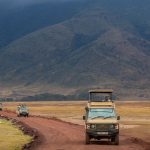
The Toyota Land Cruiser is the backbone of East African safaris. Valley Safaris runs the extended version, seating six to seven guests with window seats for everyone, plus the shortie version for smaller groups of four.
Key features:
- Full-time 4×4 drivetrain with low range gearing for mud, sand, and river crossings
- Pop-up roof hatch for standing photography without leaving your seat
- Ground clearance around 22 to 23 centimeters, enough to clear rutted tracks other vehicles avoid
- Individual charging ports, a cooler box, and a two-way radio so your driver guide can call in sightings from other vehicles
What Is a Safari Van?
The classic safari van is a Toyota HiAce minibus, seating eight to twelve passengers. It is a 2WD vehicle built for tarmac and graded murram roads, not off-track terrain.
Vans work well for straightforward routes: Nairobi to Naivasha, Naivasha to Nakuru, or day trips around Amboseli’s main circuit roads in dry season. They cost less to run, so operators can offer lower per-day rates. The trade-off is capability. A van cannot follow a 4×4 down a muddy track to a leopard sighting off the main road.
Land Cruiser vs Safari Van Kenya: Quick Comparison
| Feature | Land Cruiser (4×4) | Safari Van (2WD) |
|---|---|---|
| Seating capacity | 4 to 7 with window seats | 8 to 12, some middle seats without window access |
| Ground clearance | About 22 to 23 cm | About 16 to 18 cm |
| Pop-up roof | Standard | Sometimes, varies by operator |
| Masai Mara Reserve access | Allowed | Restricted under Narok County’s 2024 rule |
| Best for | Mara, Amboseli off-track routes, wet season | Nairobi to Naivasha to Nakuru tarmac loop, dry season |
| Valley Safaris rate (per vehicle, per day)* | USD 250 to 320 | USD 150 to 200 |
| Typical group size per vehicle | 2 to 6 | 6 to 10 |
*Indicative range. Excludes park fees, fuel surcharges on remote routes, and guide accommodation for multi-day trips. Confirm exact pricing for your dates and group size when you book.
Terrain and Off-Road Capability
This is where the two vehicles really diverge. The road from Narok town into the Mara covers roughly 50 km of murram that turns to deep mud after rain. A Land Cruiser’s 4×4 system and higher clearance get through it. A 2WD van often cannot, which is part of why the county rule exists.
Amboseli tells a similar story. The park’s main loop roads near Observation Hill are graded and manageable for a van in dry weather. But the tracks toward Kimana or the swamp edges, where elephants gather at dusk, get soft and rutted. A Land Cruiser handles both. A van is limited to the main circuit.
Lake Nakuru National Park and Hell’s Gate near Naivasha are gentler. Roads are shorter and better maintained, so a van copes well there in most conditions.
Comfort, Seating, and Photography
Every seat in a Land Cruiser gets a window, and the pop-up roof means you can stand and shoot photos without disturbing anyone else. For couples or small groups who want unobstructed views, this matters more than people expect on their first game drive.
Vans seat more people, which lowers the cost per person, but middle-row passengers often lack a clear window view. For a deeper look at how roof style affects your photos, see our guide to pop-up roof vs. open-sided vehicles for safari photos.
If photography is the main reason for your trip, a Land Cruiser or an open-sided vehicle is worth the extra cost. A van works better for travelers who care more about the overall experience than getting the perfect shot.
Cost Comparison: What You Actually Pay
Numbers matter more than vague talk of “upgrade fees.” With Valley Safaris, a Land Cruiser typically runs USD 250 to 320 per vehicle per day, shared among 2 to 6 guests. A safari van runs USD 150 to 200 per day, shared among 6 to 10 guests.
Per person, the gap narrows. On a 4-day Mara trip, a couple splitting a Land Cruiser might pay around USD 500 to 640 each toward vehicle costs. A group of eight sharing a van pays closer to USD 60 to 80 each per day. The van looks cheaper until you factor in that it may not be allowed into the reserve at all.
Park fees add up separately. The Masai Mara conservation fee now runs USD 100 per adult per day from January to June and USD 200 per adult per day from July to December, with similar tiered rates in the Mara Triangle. We break down the full picture in our post on Masai Mara conservation fee changes.
Which Vehicle Fits Your Itinerary
The honest answer depends on where you are going, not on which vehicle sounds nicer in a brochure.
- Nairobi to Naivasha to Nakuru, dry season: A van works fine. Roads are tarmac or well-graded murram the whole way.
- Masai Mara, any season: Book a Land Cruiser. The 2WD rule and the terrain both point the same direction.
- Amboseli, dry season, main circuit only: A van can manage, but a Land Cruiser opens up more of the park.
- Any itinerary in the long rains, March to May, or short rains, November: Choose a Land Cruiser. Even tarmac routes get rough shoulders and washouts.
- First-time travelers unsure what they want: Start by reading our guide on choosing between a package safari and a custom itinerary. Vehicle choice often falls out naturally once your route is set.
The Valley Safaris Difference
We do not put clients in a van and call it a Land Cruiser trip in disguise. When you book with Valley Safaris, you know exactly which vehicle you are getting, its seating capacity, and whether it is legal for your route before you pay a deposit.
Our fleet includes extended Land Cruisers for Mara and Amboseli circuits, shortie Land Cruisers for smaller private groups, and safari vans for tarmac-friendly routes like the Naivasha and Nakuru loop. Every driver guide carries a two-way radio, so if another vehicle spots a leopard near Musiara Marsh, you hear about it in minutes.
We also tell clients when a van will not cut it, even if it costs us a sale. A first-time traveler who books a Mara trip expecting to save money on a van, only to get turned away at Sekenani Gate, is not a client we want to disappoint. We would rather set the right expectation on day one.
Ready to Plan Your Safari?
Whether you need a Land Cruiser for the Mara or a van for a Rift Valley tarmac loop, we will match the vehicle to your route, not the other way around. Browse our Masai Mara safari packages or reach out through our contact page to start planning your trip.