
You have already done the Masai Mara. Now you are eyeing Samburu, Laikipia, or the Kaya forests near the coast, and a fair question is nagging at you: should you carbon offset flights for your next Kenya safari, or is that just a nice sticker on a guilty conscience?
Most guides online tell you to buy a credit and move on. We think you deserve the real numbers first, the honest controversy around offsetting, and a named project you can actually check for yourself.
How Much CO2 Does the Flight to Kenya Actually Produce?
A round trip economy flight from London Heathrow to Nairobi’s Jomo Kenyatta International Airport covers about 13,600 km and produces somewhere in the range of 1.6 to 2.0 tonnes of CO2 per passenger. That range is indicative, since exact figures shift with aircraft type, load factor, and the calculator you use.
Flying from New York or Toronto roughly doubles that. A JFK to Nairobi round trip covers close to 22,800 km, landing you in the 2.8 to 3.4 tonne range. Toronto is similar, just over 23,000 km round trip.
For comparison, the average Kenyan resident produces under 1 tonne of CO2 a year for their entire life. One long haul flight can outweigh that many times over. That is not a reason to feel bad. It is a reason to know what you are working with before you decide what to do about it.
What Carbon Offsetting Actually Does
Offsetting means paying someone else to reduce or avoid emissions equal to yours, usually by funding a forest protection project, a clean cookstove program, or a renewable energy scheme. You are not undoing your flight. You are funding a project that, in theory, keeps an equivalent amount of carbon out of the atmosphere somewhere else.
The idea is sound in principle. The problem is verification. Did that forest actually need protecting, or was it never going to be cut down anyway? Did that credit get sold once, or ten times over? This is where things get messy.
Is Offsetting Legit, or Just Marketing?
In January 2023, an investigation by The Guardian, Die Zeit, and SourceMaterial looked at rainforest carbon credits certified by Verra, the largest certifier in the voluntary market. They found that more than 90% of the credits studied likely did not represent real carbon reductions. Some projects overstated the deforestation risk they were supposedly preventing, which inflated the credits sold.
That finding shook the whole industry, and rightly so. It does not mean every offset project is worthless. It means you cannot buy blind. A credit is only as good as the data behind it, and some registries police that data better than others.
How to Judge Offset Quality: Gold Standard vs Verra
Two names dominate the market. Verra runs the Verified Carbon Standard, the largest registry by volume, and it has tightened its methodology since the 2023 findings. Gold Standard was founded by WWF and other NGOs specifically to set a higher bar, with stronger community benefit requirements and third-party audits.
Neither is perfect, but both are far better than an airline’s one-click “carbon neutral” add-on with no named project behind it. In 2023, the Integrity Council for the Voluntary Carbon Market published the Core Carbon Principles, a shared benchmark meant to weed out weak projects, and major registries including Verra and Gold Standard have been aligning their programs to it.
A quick way to check quality before you pay for anything:
- The project is named and searchable on the registry’s public database.
- It shows a recent verification date, not one from a decade ago.
- It reports co-benefits, like jobs or clean water, alongside the carbon numbers.
One Kenya-based project worth knowing is the Kasigau Corridor REDD+ Project, run by Wildlife Works between Tsavo East and Tsavo West National Parks. It protects dryland forest, employs people from the local Taita community, and has been validated under the Verified Carbon Standard and the Climate, Community and Biodiversity Standards since 2011. Registry ratings shift over time, so check the current status on Verra’s public database before you buy, rather than taking any single article’s word for it, including ours.
The Part Nobody Calculates: Carbon Offset Flights Inside Your Kenya Safari
Here is what the generic guides skip. Your international flight is only part of the trip. Once you land at Wilson Airport in Nairobi, a fly-in safari adds more legs, and a balloon ride or a helicopter tour adds more still.
| Flight leg | Distance | Indicative CO2 per passenger | Indicative offset cost (~$12/tonne) |
|---|---|---|---|
| London Heathrow to Nairobi JKIA, round trip | 13,600 km | 1.6-2.0 tonnes | $19-24 |
| New York JFK to Nairobi JKIA, round trip | 22,800 km | 2.8-3.4 tonnes | $34-41 |
| Toronto Pearson to Nairobi JKIA, round trip | 23,400 km | 2.9-3.5 tonnes | $35-42 |
| Nairobi Wilson to Musiara airstrip, Masai Mara | 270 km, one way | 60-90 kg | $0.70-1.10 |
| Nairobi Wilson to Kalama airstrip, Samburu | 325 km, one way | 75-100 kg | $0.90-1.20 |
| Nairobi Wilson to Nanyuki, Laikipia | 180 km, one way | 45-65 kg | $0.55-0.80 |
| Hot air balloon safari, Masai Mara, per passenger | about 1 hour | 25-35 kg | $0.30-0.42 |
| Helicopter tour, Nairobi to Amboseli or Mara, per passenger | about 1 hour, shared | 120-200 kg | $1.45-2.40 |
The good news is that even a full week of domestic hopping, a balloon ride, and a helicopter add-on together usually add less than one extra tonne of CO2 to a trip already weighted by the long haul flight. If you are curious about a Masai Mara hot air balloon safari or want the full picture on helicopter safaris in Kenya, both pages break the costs down further, carbon included.
Lower Your Footprint Before You Buy a Single Credit
Offsetting is a last step, not a first one. Before you reach for a credit, a few choices cut real emissions.
Consider a road safari instead of a fly-in for at least one leg. Nairobi to the Masai Mara by road takes about 5 to 6 hours and produces a fraction of the CO2 of a charter flight, though it costs you a travel day. For repeat visitors chasing quieter ground, driving overland into Laikipia via Nanyuki, roughly 3 hours from Nairobi, is an easy trade.
If the coast is on your list, skip the domestic flight to Mombasa and take the SGR train, about 4.5 hours from Nairobi, then head south by road to visit the Kaya forests near Diani. These sacred Mijikenda forest groves are a UNESCO World Heritage site and a genuinely quiet, low-traffic addition to a Kenya itinerary.
Ask your operator whether the lodge runs on solar. Many camps in the Mara North and Naboisho conservancies, and most Laikipia properties, now run largely or fully on solar power with generator backup only. That is worth asking about directly, since it varies camp by camp and changes year to year.
Traveling in the shoulder season, from March to May or November, also spreads demand more evenly and eases pressure on the most popular access roads and airstrips. If you are working out how the numbers fit your trip overall, our guide to budgeting for an all-inclusive safari is a good place to see where flights sit against the rest of your costs.
Does Safari Tourism Actually Fund Conservation?
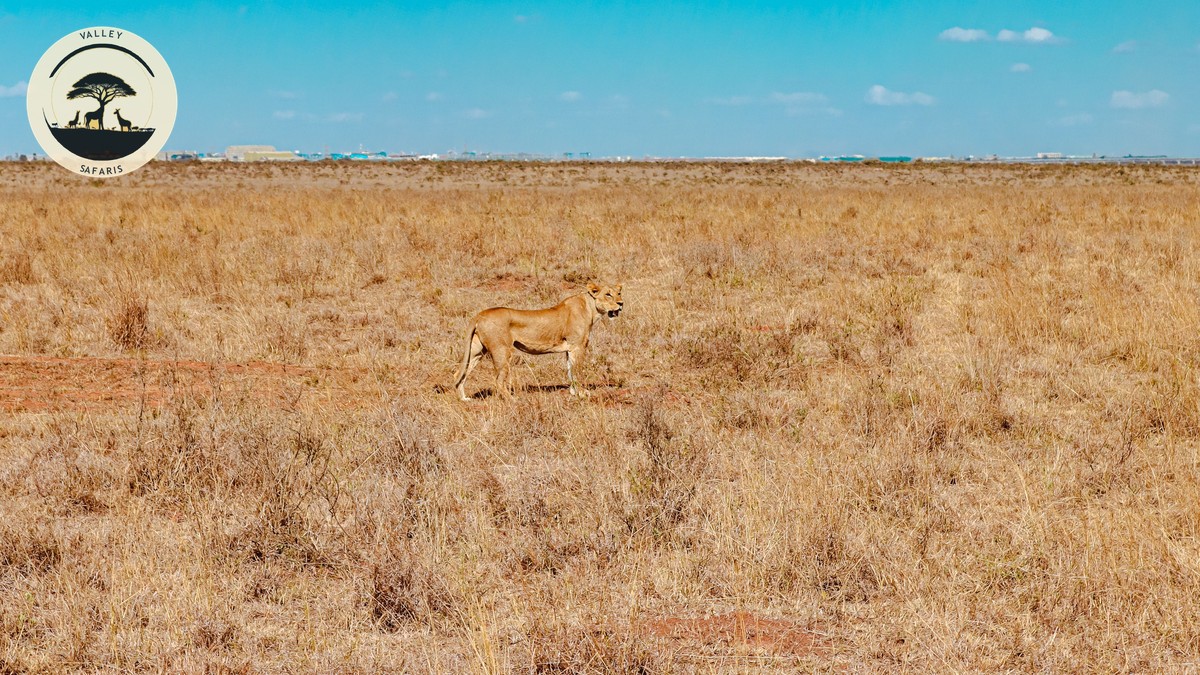
This is worth asking honestly, because it changes the calculation. Kenya’s conservancy model, used across the Mara ecosystem, Laikipia, and Samburu, channels a portion of every visitor’s conservancy fee directly to landowners who agree not to fence or farm their land. In the Mara conservancies alone, this system supports several thousand square kilometers of wildlife habitat that exists specifically because tourism pays for it.
That does not cancel out your flight’s emissions. It does mean that not flying at all has a cost too, one measured in lost income for the people and land protecting that wildlife.
The Valley Safaris Difference
We do not sell blanket “carbon neutral” packages, because we think that promise is often thinner than it looks. What we do instead is give you the real numbers for your specific itinerary, road option versus fly-in versus flying plus a balloon or helicopter add-on, so you can decide what matters to you.
We work with camps in Mara North, Naboisho, Laikipia, and Samburu that report their energy sources honestly, and we will tell you plainly when a lodge still runs mostly on diesel. If you want to offset, we can point you to Kasigau Corridor and other registry-verified projects rather than a generic add-on at checkout. No pressure either way, just the facts so the decision is yours.
Plan It With Us
If you are weighing a fly-in Mara return against an overland run into Laikipia, or wondering whether a balloon ride is worth the extra kilogram of CO2, we are happy to walk through it with you. Get in touch through our contact page or take a look at our Kenya safari tours to start shaping the trip.