You’ve done the Mara game drives. You know the Big Five checklist by heart. Now you want the Kenya behind a story, not just the wildlife highlight reel. This guide to Out of Africa film locations Kenya covers the real places, the real distances, and what you can skip. That’s what pulls people back to Out of Africa, the 1985 film with Meryl Streep and Robert Redford, based on Karen Blixen’s 1937 memoir of the same name.
Blixen ran a coffee farm below the Ngong Hills from 1914 to 1931. Her book covers the farm, her love affair with hunter and pilot Denys Finch Hatton, and the collapse of both. The film won seven Oscars and sent a wave of visitors to Kenya chasing the same golden light. Forty years later, people still ask where it was filmed and whether the real places match the myth.
Here’s the honest answer. Some locations are five minutes from your Nairobi hotel. Others mean a five hour drive for a scene that lasted ninety seconds on screen. This breakdown sorts out which is which, with real distances, real prices, and a route that actually works.
Background: The Film and the Woman Behind It
Karen Blixen, writing under the pen name Isak Dinesen, published Out of Africa in 1937 after returning to Denmark in defeat. Her coffee farm never turned a profit. Finch Hatton died in a plane crash in 1931. The film, directed by Sydney Pollack, was shot largely on location in Kenya rather than on studio sets, which is why so many of the real places still exist and can be visited today.
Most of the film was not shot at Blixen’s actual farm. Nairobi had grown too much by the 1980s to double convincingly for the 1910s. Instead, Pollack’s team built a farmhouse set near the Mbagathi River and used reserves across the country for the safari scenes. Knowing this upfront saves you from disappointment later.
Karen Blixen Museum: The Real House, Not the Film Set
This is where most people start, and it’s worth it. The Karen Blixen Museum sits in Mbogani House, Blixen’s actual farmhouse, in the Nairobi suburb that now carries her name. It’s about 10 km from the city center, a 20 to 30 minute drive depending on traffic.
The house was not used for filming. The production built a separate replica farmhouse for the movie. But Mbogani House is furnished with period pieces, some belonging to Blixen herself, and the grounds still look out toward the Ngong Hills the way she described them. Entry runs around KES 1,200 for non-resident adults, with the museum open daily from 9:30am to 6pm.
Since you’re already out this way, pair the Karen Blixen Museum with a Nairobi Giraffe Centre day trip. The Giraffe Centre is a 10 minute drive from the museum, and combining both makes a full, satisfying half day rather than a rushed 45 minute stop.
Ngong Hills and Denys Finch Hatton’s Grave
The Ngong Hills rise about 25 km southwest of Nairobi, and they’re unmistakable in both the book and the film. Finch Hatton’s grave sits on a ridge near the hills, close to where he asked to be buried. Lions were reportedly seen resting near the grave in the years after his death, a detail Blixen wrote about herself.
Getting there takes a short hike from the nearest access point, and the views over the Rift Valley are worth the climb on a clear morning. Go early. Afternoon cloud cover rolls in often and blocks the view you came for.
Muthaiga Country Club
Muthaiga Country Club, founded in 1913, appears in both the book and the film as the social hub for Nairobi’s colonial-era settlers. It’s still an active private club today, not open to casual visitors without a member’s invitation. Most guests see it from the outside during a Nairobi city tour, or skip it entirely. It’s a nice historical footnote, not a must-see stop.
Maasai Mara and the Mara River
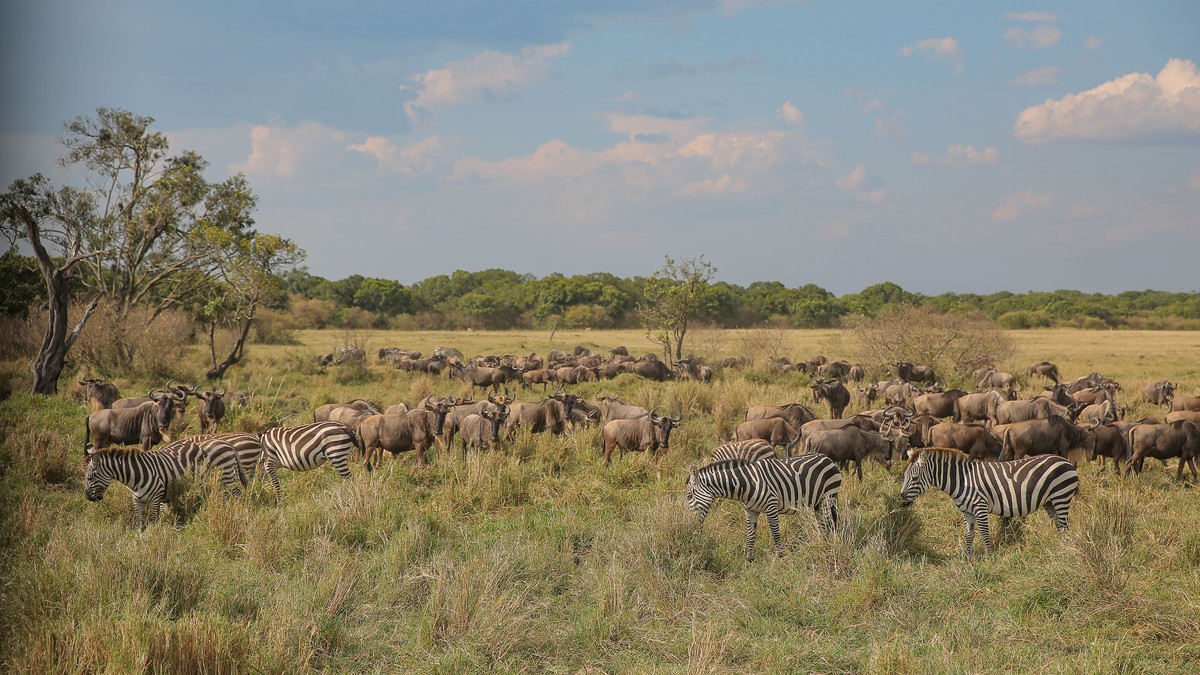
This is the location everyone remembers, even if they don’t know its name. The hair washing scene by the river and much of the film’s iconic aerial photography were shot around the Maasai Mara and the Mara River. The Mara sits roughly 270 km from Nairobi, about a 5 to 6 hour drive or a 45 minute scheduled flight from Wilson Airport.
If you’re building an Out of Africa themed trip, the Mara earns its place easily. It’s already the anchor of most Kenya safaris, and it delivers on the exact scenery the film made famous, wide grass plains, acacia trees, and river crossings.
While you’re there, a sunrise flight over the plains is one of the closest things to the film’s opening shots. Check the current Masai Mara hot air balloon safari cost before you go, since prices shift with fuel costs and season, but expect a range around USD 450 to 550 per person including a champagne bush breakfast.
Shaba National Reserve: Worth the Detour?
Shaba National Reserve, in Samburu county, was the setting for the lion attack scene and much of the film’s wildest, most remote-feeling footage. It’s also genuinely remote from a standard Mara-based itinerary, about 350 km north of Nairobi and closer to 5 to 6 hours by road.
Here’s the honest verdict most listicles skip. Shaba is stunning and far less crowded than the Mara, with the Ewaso Nyiro River cutting through dry, dramatic country. But if your trip is already anchored on the Mara, adding Shaba means a full extra day of driving or a domestic flight to Samburu, not a quick add-on. It makes sense if you have 8 or more days in Kenya and want a genuinely different landscape and species list. For a first Out of Africa pilgrimage on a 5 to 7 day trip, it’s the location most people should skip, or save for a return visit. If you’re weighing it, it helps to understand how Shaba’s Samburu ecosystem compares to the Mara before committing the extra days.
Tsavo and the Plane Crash Site
Denys Finch Hatton died on May 14, 1931, when his Gipsy Moth biplane crashed near Voi, on the edge of Tsavo. The site isn’t marked as a formal tourist attraction, and there’s little to see beyond open bush near the airstrip. It’s a footnote for Out of Africa completists rather than a destination in its own right. Most itineraries pass through Tsavo anyway on the road between Nairobi and Mombasa, so it costs nothing extra to have your guide point out the general area.
Mombasa Beaches
The film’s coastal scenes used beaches around Mombasa, standing in for the ship voyages that bookend the story. Diani Beach and the coastline near Mombasa still deliver the same white sand and turquoise water today. It’s a good way to close a Kenya trip, though it’s a beach add-on rather than a filming pilgrimage, about a 6 to 7 hour drive or 1 hour flight from Nairobi.
Out of Africa Film Locations Kenya: Distances and Verdicts at a Glance
| Location | Distance from Nairobi | Drive Time | Approx. Cost | Worth the Trip? |
|---|---|---|---|---|
| Karen Blixen Museum | 10 km | 20-30 min | KES 1,200 entry | Yes, easy add-on |
| Ngong Hills / Finch Hatton grave | 25 km | 45-60 min | Free to low fee | Yes, half day |
| Muthaiga Country Club | 8 km | 20 min | Members only | Optional, drive-by |
| Maasai Mara / Mara River | 270 km | 5-6 hrs (or 45 min flight) | USD 80-200/day park fees | Yes, core stop |
| Shaba National Reserve | 350 km | 5-6 hrs | USD 70 park fee/day | Only on 8+ day trips |
| Tsavo (Voi area) | 330 km | 5 hrs | Passed en route | Minor detour only |
| Mombasa / Diani beaches | 490 km | 6-7 hrs (or 1 hr flight) | Varies by resort | Yes, as a trip closer |
Where to Stay
Karen Blixen Camp, near the Mara’s Talek River, borrows the name and leans into the theme with colonial-style tents and a garden setting. Rates typically run USD 300 to 500 per person per night on a full board basis, depending on season. It’s not the only option. Several tented camps around the Mara North and Naboisho conservancies offer the same old-safari atmosphere with better wildlife access and fewer vehicles at sightings.
The Valley Safaris Difference
Anyone can list five film locations and call it a guide. What actually matters is whether those stops fit into real days on the ground, with real drive times and honest trade-offs. We plan Out of Africa themed trips the way we’d plan our own, starting with what’s genuinely worth your time.
That means pairing the Karen Blixen Museum with the Giraffe Centre so your Nairobi day isn’t wasted. It means being upfront when Shaba adds a full extra day, instead of pretending it’s a quick side trip. And it means booking balloon safaris and camps at current rates, not numbers copied from an old brochure. We’ve walked Mbogani House, watched the sun set over the Mara River, and know which Samburu camps are worth the extra hours north. That ground knowledge is what turns a list of movie trivia into a trip you’ll actually enjoy.
Plan Your Out of Africa Trip
If this trail has you sketching an itinerary, we’d love to help you build it properly, from a Nairobi museum morning to sundowners by the Mara River. Have a look at our Kenya safari tours or get in touch through our contact page and we’ll help you plan the trip.